The short answer
In Seattle, an interior remodel can start in any month, but work that opens the roof, the outside walls or the ground is easiest from June to September: NOAA's 1991 to 2020 normals put only 4.63 of Sea-Tac's 39.34 inches of yearly precipitation in those four months. Count back from that start. SDCI screens a small STFI permit in a few days, but on November 26, 2026 its dashboard showed 64 days in city control for three in four house addition and alteration permits, and the city says applicants experience about twice that.
Key points
- 01Interior remodels can start in any month; additions, roof work and foundations are easiest in the dry months of June to September.
- 02At Sea-Tac, October through March brings 29.65 of the year's 39.34 inches of precipitation, about 75%, according to NOAA's 1991 to 2020 normals.
- 03From October 1 to April 30, Seattle's Stormwater Code allows no soil to stay exposed and unworked for more than two days.
- 04SDCI's figures point to about four months from acceptance to permit for a house addition or alteration that needs full review, so a June start means a complete application in early January.
- 05Ask each contractor for its start date and the order times for cabinets, windows and fixtures rather than assuming them.
In this article (8 sections)
- 01Is there a best month to start a remodel in Seattle?
- 02Which months are rainiest in Seattle?
- 03What does Seattle require for digging in the rainy season?
- 04How long does the permit take before work can start?
- 05How do you count back from the day you want work to start?
- 06Which projects suit the rainy months?
- 07Which dates on the calendar can change the plan?
- 08How far ahead should you contact a contractor?
Is there a best month to start a remodel in Seattle?
For interior work, no. A kitchen, a bathroom or a basement is built inside a closed house, and the rain makes little difference. For work that opens the house or the ground, such as an addition, a second story, a new roof line, foundation work or a backyard cottage, the dry months from June to September are the easiest, and the real question is when the design and the permit must be finished to start then.
Two calendars set the date: the weather's and the permit office's. The sections below give the published figures for both.
- Normal yearly precipitation at Sea-Tac, 1991 to 2020 (NOAA)
- 39.34 in
- Normal yearly precipitation at Sea-Tac, 1991 to 2020 (NOAA)
- Share of it that falls from October through March
- 75%
- Share of it that falls from October through March
- Days in city control for 3 of 4 Seattle house addition and alteration permits (SDCI, Nov. 26, 2026)
- 64 days
- Days in city control for 3 of 4 Seattle house addition and alteration permits (SDCI, Nov. 26, 2026)
Which months are rainiest in Seattle?
November, December and January. NOAA's 1991 to 2020 climate normals for Seattle-Tacoma International Airport show 6.31 inches of precipitation in a normal November, with about 13 days of a tenth of an inch or more, against 0.60 inches and fewer than two such days in July.
| Month | Precipitation (inches) | Days with 0.10 inch or more |
|---|---|---|
| January | 5.78 | 12.7 |
| February | 3.76 | 9.3 |
| March | 4.17 | 10.9 |
| April | 3.18 | 8.7 |
| May | 1.88 | 5.8 |
| June | 1.45 | 4.3 |
| July | 0.60 | 1.8 |
| August | 0.97 | 2.3 |
| September | 1.61 | 4.2 |
| October | 3.91 | 8.4 |
| November | 6.31 | 12.9 |
| December | 5.72 | 12.1 |
NOAA National Centers for Environmental Information, U.S. Climate Normals 1991 to 2020, station USW00024233. Yearly total 39.34 inches. Rainfall varies across the region.
October through March brings 29.65 inches, about 75% of the year's total. June through September brings 4.63 inches, about 12%. April and May sit between, at 3.18 and 1.88 inches.
What does Seattle require for digging in the rainy season?
Seattle's Stormwater Code sets a shorter limit for bare soil in the wet season. For every project, from October 1 to April 30 no soil may stay exposed and unworked for more than two days; from May 1 to September 30 the limit is seven days. Soil has to be stabilized at the end of the shift before a weekend or a holiday if the forecast calls for it, and stockpiles must be protected and kept away from storm drains (SMC 22.805.020, in the city's July 2026 compilation).
In practice, a foundation dug in November means covering the excavation, the dirt pile and any bare yard every couple of days, and dealing with rainwater in the footing trenches before concrete. A summer dig avoids most of that work. A project that disturbs more than 750 square feet of land also needs an SDCI pre-application site visit before the permit application, and one on a steep slope or in another critical area needs more studies.
Other cities have their own stormwater rules; the local remodel guides list each permit office.
How long does the permit take before work can start?
It depends on the permit. The Seattle Department of Construction and Inspections (SDCI) says screening for a subject-to-field-inspection (STFI) permit, the quicker permit for small projects, takes a few days. A project that needs full plan review waits longer: SDCI says it can usually take in a complete application within 2 to 3 weeks of upload, and tries to finish its initial review of simple applications in 2 to 3 weeks and of complex ones in 8 weeks. Rounds of corrections follow.
SDCI also publishes goals and current results. From October 1, 2025, the goal for a single-family addition or alteration is 30 days in city control for 75% of permits. On November 26, 2026, the city's dashboard showed 64 days at that 75th percentile, and SDCI says the total time an applicant experiences is roughly twice the days in city control.
| Permit | Published figure | Source |
|---|---|---|
| Seattle STFI permit (small remodels and additions) | Screening takes a few days | SDCI |
| Seattle full review: intake | Usually within 2 to 3 weeks of a complete upload | SDCI |
| Seattle full review: initial review | 2 to 3 weeks for simple applications, 8 weeks for complex ones | SDCI |
| Seattle single-family addition or alteration, intake to issue | Goal 30 days in city control; 64 days at the 75th percentile on Nov. 26, 2026 | SDCI permit performance |
| Seattle pre-approved DADU plan, intake to issue | Goal 30 days in city control; 60 days at the 75th percentile on Nov. 26, 2026 | SDCI permit performance |
| Bellevue remodel without plan review | Typically within one day | City of Bellevue |
| Bellevue single-family remodel or addition with plan review | Targets: first review 14 days, each revision 10 days | City of Bellevue |
Other cities publish different figures, and some publish none. See how long remodel permits take in Seattle and the Eastside for the full comparison, and the Seattle remodel guide for the permit office.
How do you count back from the day you want work to start?
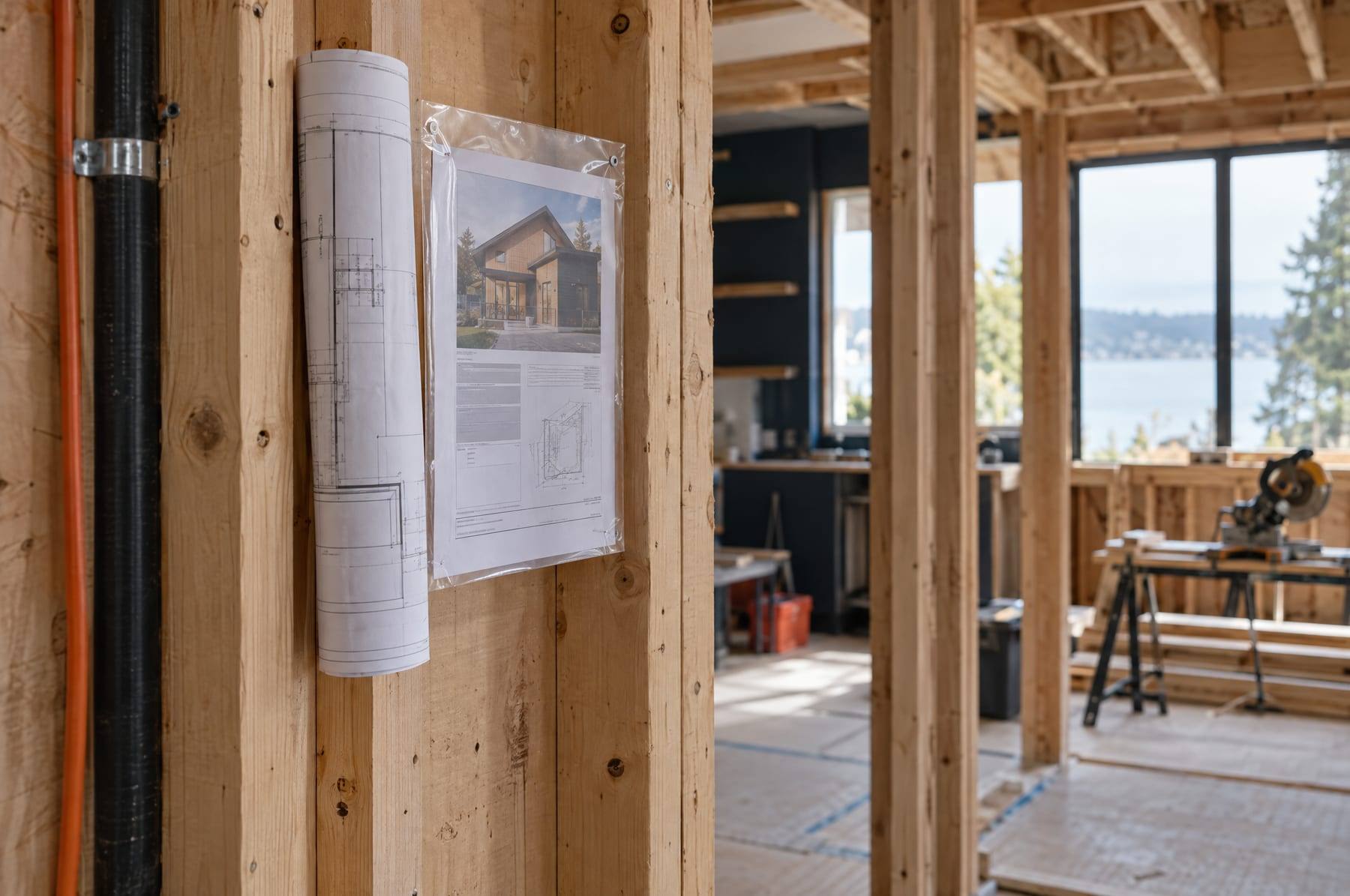
Start from the day you want the crew on site and subtract each step. Here is an example for a ground-level addition in Seattle that needs full review, aimed at a June 1 start:
- 01
June 1: work starts
The permit is issued and posted on site, and materials with long order times were ordered once the design was final.
- 02
Late January: application accepted
At 64 days in city control, roughly doubled for the applicant's side, the city's figures point to about four months from acceptance to permit. Corrections answered quickly keep it near that; slow answers stretch it.
- 03
Early January: complete application uploaded
SDCI says it can usually take in a complete application within 2 to 3 weeks.
- 04
The fall before: design and engineering finished
Drawings, structural calculations, energy code forms and any surveys or soils reports the site needs. Ask your designer or design-build contractor how long this takes for your project.
- 05
Before that: contractor chosen
On a design-build project the builder is chosen before design starts. On the architect-first path, bidding happens after the drawings are done; see design-build or architect first.
The arithmetic is rough on purpose: the 75th percentile means one permit in four takes longer. For a kitchen or a bathroom that fits the STFI permit, screening takes days, so the design, the selections and the order times for cabinets and fixtures usually set the start date instead.
Which projects suit the rainy months?
Interior projects fit the wet season well, and planning a summer project during the winter is how the permit gets done in time.
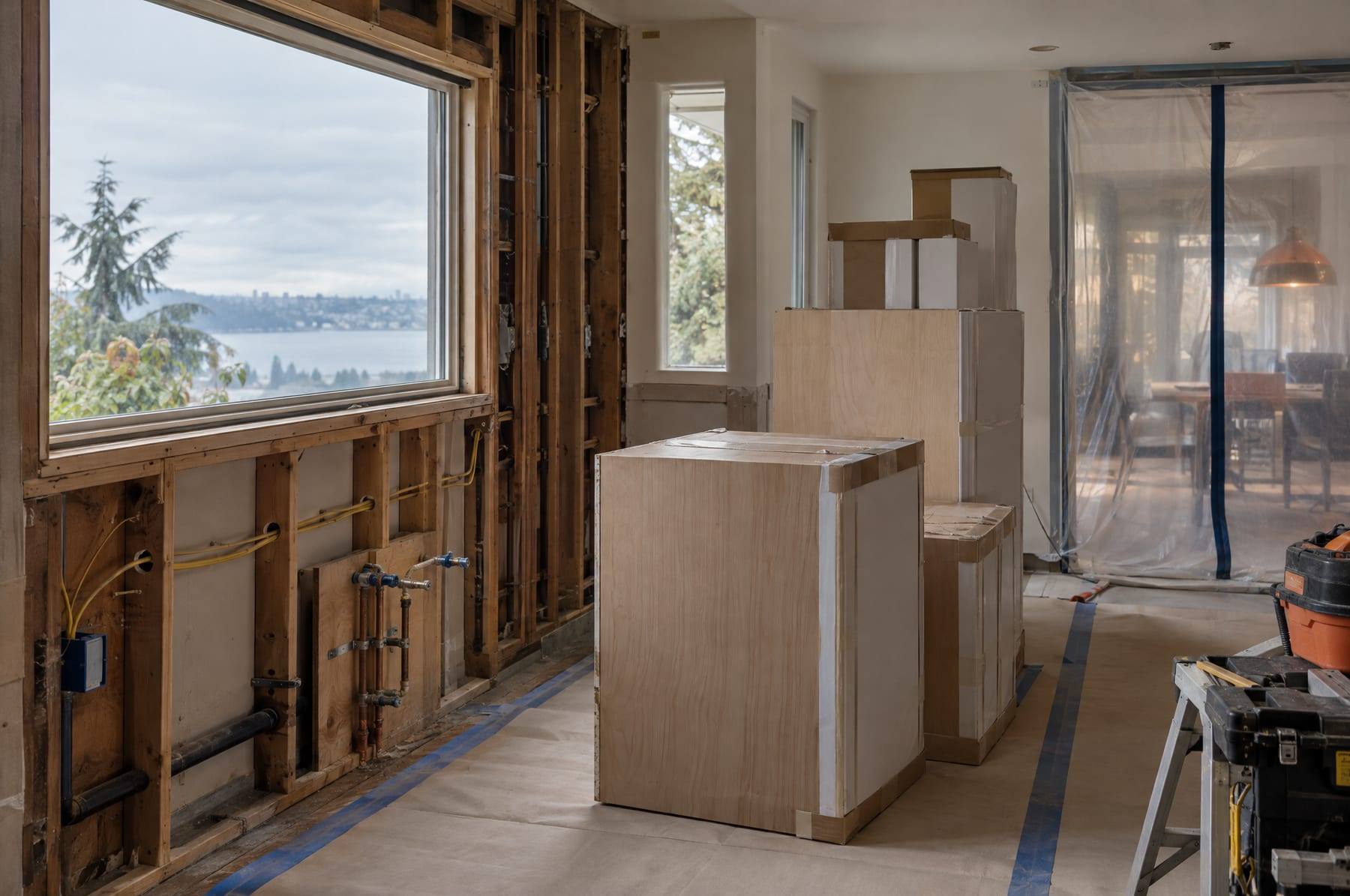
- Kitchens and bathrooms. The work happens inside a closed house. Vents for a range hood or a bathroom fan are small openings that can be made on a dry day.
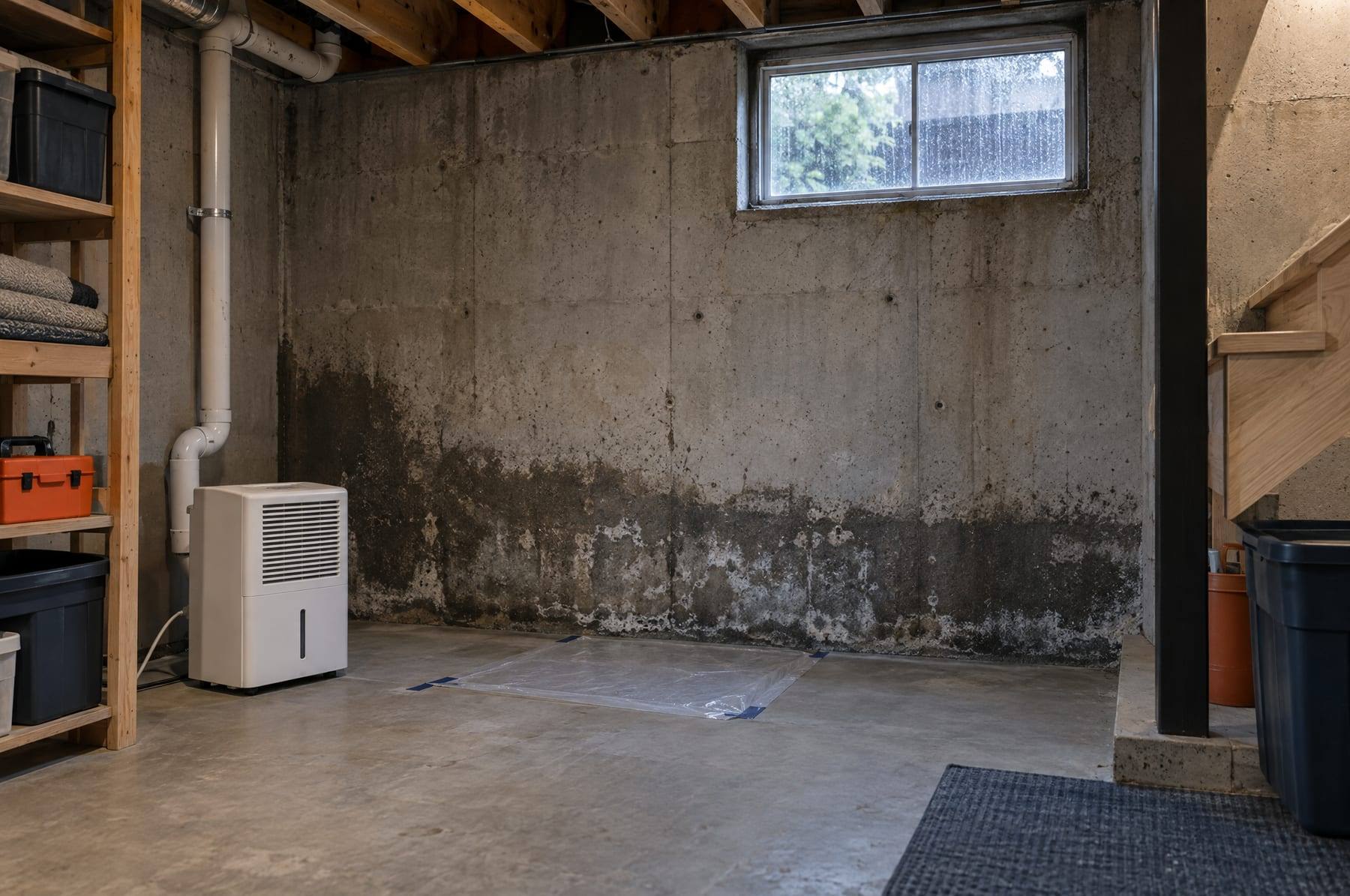
- Basements. A wet winter shows where water gets in, and that is worth knowing before walls are framed. See keeping a basement dry before you finish it.
- Design and permits for summer work. Winter is when the drawings and the application for a June start need to be done.
- Electrical upgrades. Mostly inside work. If the project needs an electrical service change or a new service, SDCI notes that it goes through Seattle City Light; see whether your remodel needs a bigger panel.
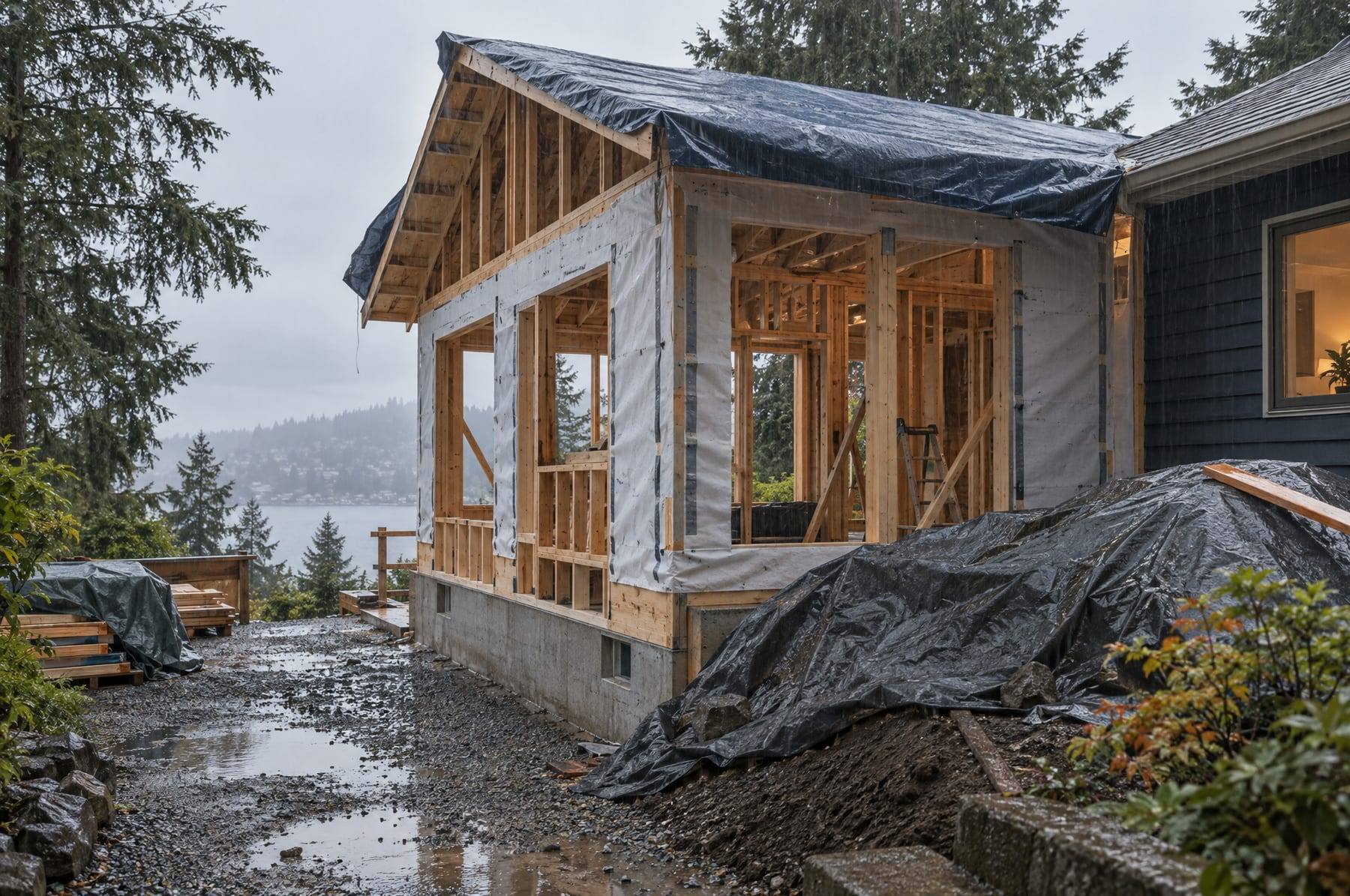
Work best kept out of the wettest months: taking a roof off for a second story, opening exterior walls for a large addition, foundation and drainage work, and exterior painting. When it cannot wait, plan for temporary roofing, tarps and the wet-season soil rules above.
Which dates on the calendar can change the plan?
- Sales tax rates. The Department of Revenue publishes local rates by quarter, and they can change from one quarter to the next. Seattle's combined rate is 10.55% for October 1 to December 31, 2026, charged on the whole contract. See sales tax on remodeling.
- The federal energy credit. The IRS says the Energy Efficient Home Improvement Credit can be claimed for improvements made through December 31, 2025, so waiting for it is no longer a reason to delay. Utility rebates have their own dates; check them with the utility, or start with the energy rebate calculator.
- Permit life. A Seattle building permit is valid for 18 months after it is issued, and a project that takes longer needs a renewal.
- Your own calendar. A kitchen out of service over a holiday you host, a new baby or the school year can matter more than the weather. Give those dates to the contractor before the schedule is set.
How far ahead should you contact a contractor?
Far enough ahead to finish the steps above, and that depends on each contractor's schedule. Schedules vary, so ask each one directly:
- When could you start construction on a project like mine?
- How long would the design and the permit drawings take?
- Which items have the longest order times, and when must they be ordered?
- What happens to the schedule if the permit takes longer than expected?
- Will the same crew stay on my job from start to finish?
Write the answers down, and put the completion date in the contract, as Washington's Department of Labor & Industries advises. The planning checklist puts every step in order.
Giant Builders Seattle prepares and files the permits for its projects, and the free in-home estimate is a good time to ask about timing for your house.
Questions people also ask
01Is winter a bad time to remodel a kitchen in Seattle?
02Can a foundation be dug in the rainy season?
03How early should I apply for a permit for a summer addition in Seattle?
04Does the rainy season make a remodel cost more?
05What is the driest month in Seattle?
Sources
- 01NOAA National Centers for Environmental Information: U.S. Climate Normals 1991 to 2020, monthly, Seattle-Tacoma International Airport (USW00024233) (read Nov 26, 2026)
- 02Seattle Stormwater Code, SMC 22.805.020 (city compilation, July 2026) (read Nov 26, 2026)
- 03Seattle SDCI: Construction permit, addition or alteration (review times, intake, permit life) (read Nov 26, 2026)
- 04Seattle SDCI: Construction permit, subject to field inspection (read Nov 26, 2026)
- 05Seattle SDCI: Construction permit performance (goals and current results) (read Nov 26, 2026)
- 06City of Bellevue: Permit review timelines (read Nov 26, 2026)
- 07Seattle SDCI: House additions and remodels (read Nov 26, 2026)
- 08Washington Dept. of Revenue: local sales and use tax rates, October 1 to December 31, 2026 (read Nov 26, 2026)
- 09Washington Dept. of Revenue: construction tax matrix (read Nov 26, 2026)
- 10IRS: Energy Efficient Home Improvement Credit (page reviewed Apr. 28, 2026) (read Nov 26, 2026)
- 11Washington L&I: Hire smart, step by step (read Nov 26, 2026)
Rules, rates and programs change. This article was checked against the sources above on the dates shown. It is general information for homeowners, not legal, tax or engineering advice for a specific property.