The short answer
Knob-and-tube wiring, the porcelain-insulator system that HUD's inspection guide says is still found fairly often in houses built before 1930, may stay in use in Seattle if it was lawful when installed and is not left unsafe or overloaded. Insulation may cover it only after a licensed electrical contractor certifies in writing that it is in good condition, and foam insulation is never allowed. A rewire needs an SDCI electrical permit: $55.48 plus $26.28 for each circuit up to 25 amps, plus a 5% technology fee, in 2026.
Key points
- 01Seattle's 2023 electrical code lets lawful knob-and-tube stay in use; new work must meet current code and not overload the old system.
- 02Energized knob-and-tube that serves no purpose must be removed or terminated, and changed circuits in living areas need arc-fault protection.
- 03Insulating over knob-and-tube needs a licensed electrical contractor's written survey, Class I insulation and correct overcurrent protection; foam is never allowed.
- 04An SDCI electrical permit for a 12-circuit rewire costs $389.38 in 2026, and an owner who lives in the house may do the work.
In this article (6 sections)
- 01What is knob-and-tube wiring, and how do I spot it?
- 02Is knob-and-tube wiring dangerous?
- 03Does Seattle require me to remove knob-and-tube when I remodel?
- 04Can I insulate an attic or walls that have knob-and-tube wiring?
- 05How is knob-and-tube replaced during a remodel?
- 06What permit does a rewire need, and what does it cost?
What is knob-and-tube wiring, and how do I spot it?
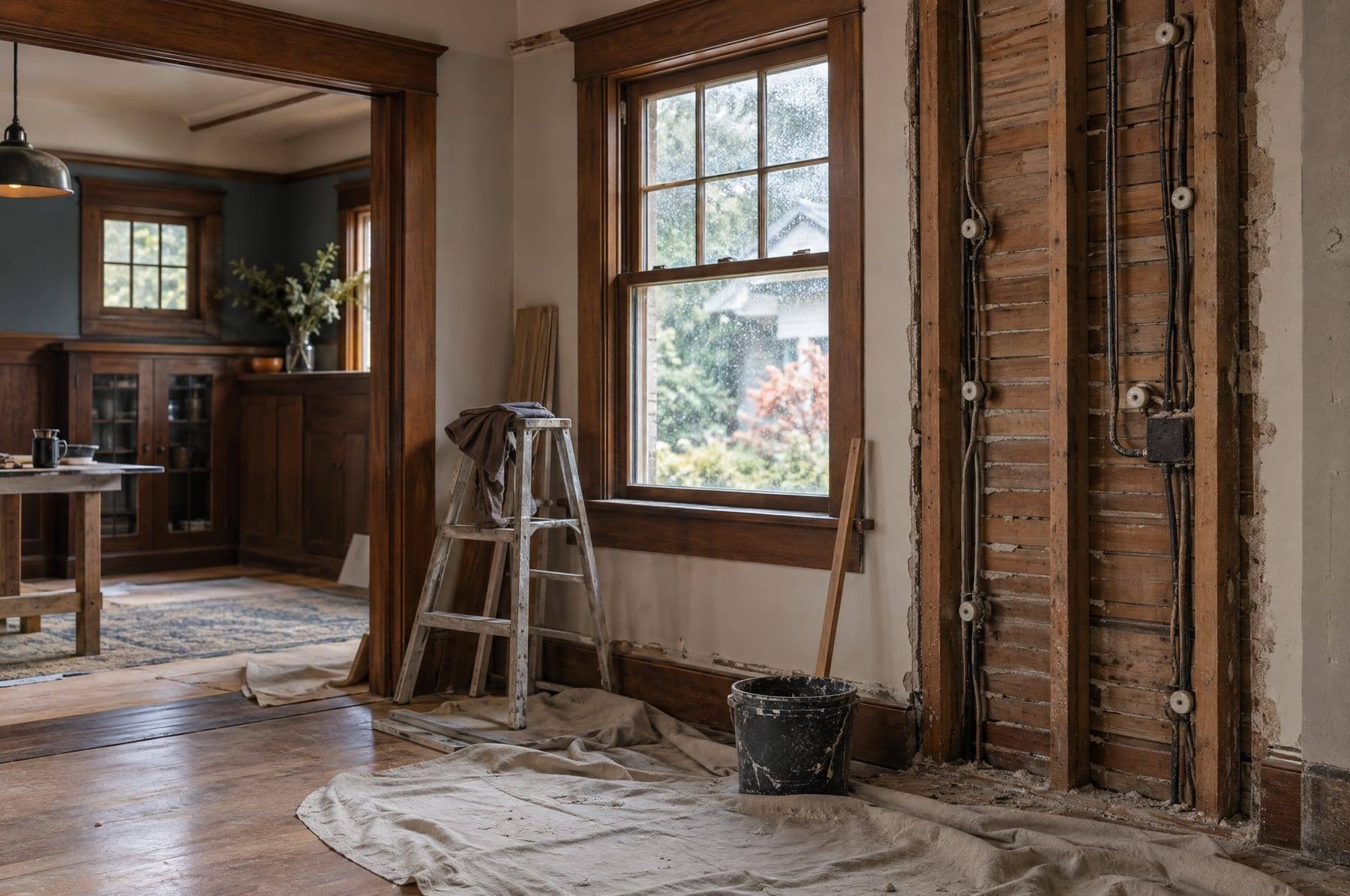
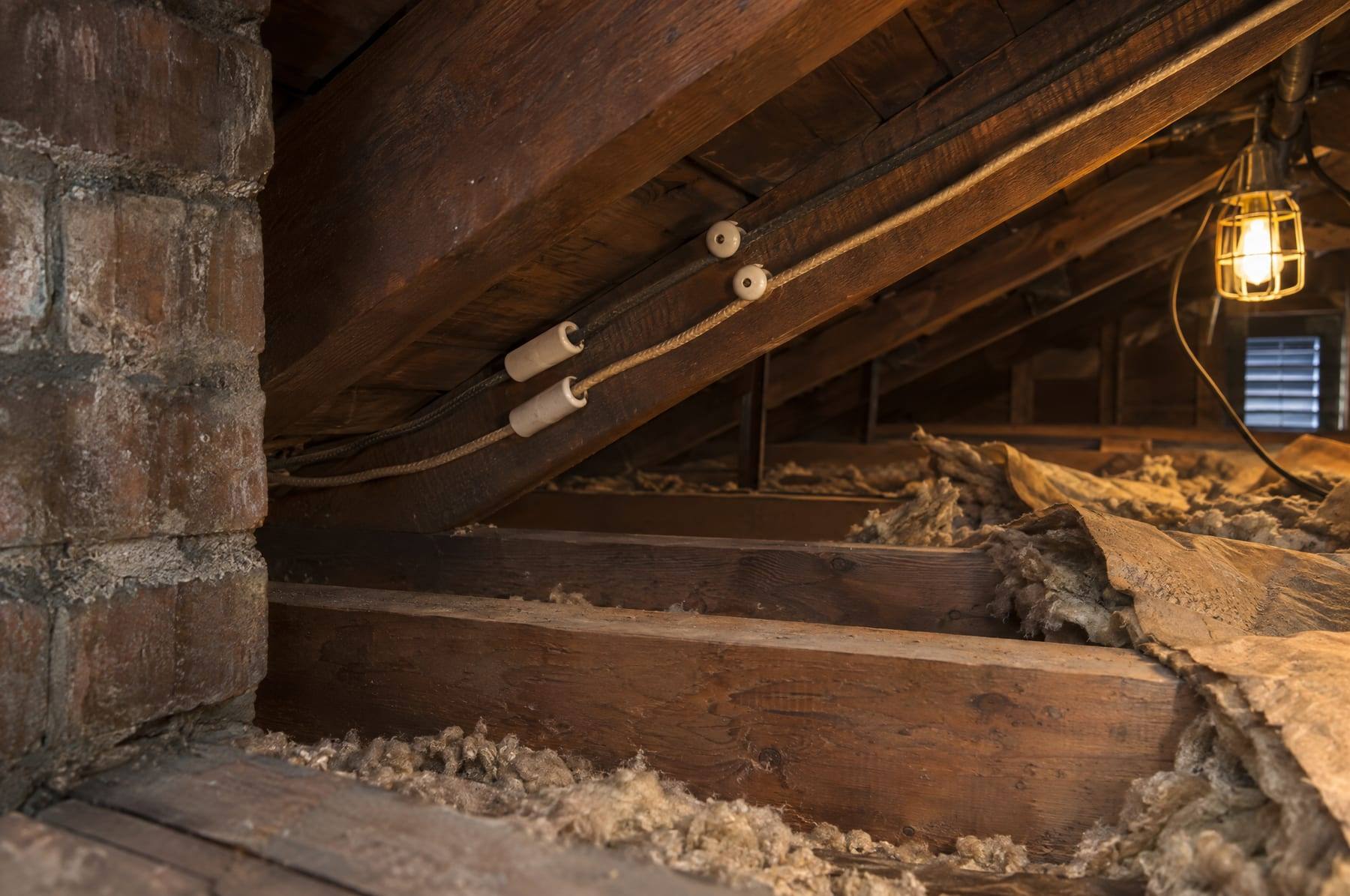
Knob-and-tube is the oldest wiring system still in use in many older houses. It runs single wires on porcelain knobs through open spaces such as attics and the spaces between joists, and through porcelain tubes where the wires pass through studs and joists. HUD's Residential Rehabilitation Inspection Guide says it is still found fairly often in houses built before 1930, which in Seattle includes most Craftsman houses.
The easiest places to see it are an unfinished attic and the joists over a basement or crawl space: separate wires held off the wood by porcelain knobs, with porcelain tubes where they pass through framing. The system has no ground wire; HUD notes that grounding all circuits was not required by the National Electrical Code before 1965. A house may have both, with knob-and-tube in the original rooms and later cable where rooms were added or remodeled, so new outlets do not prove the attic has been rewired.
Is knob-and-tube wiring dangerous?
It can be acceptable in good condition, and it becomes a hazard when its insulation fails or the circuits have been altered badly. HUD's guide says the greatest problem with such wiring is its insulation, which turns dry and brittle with age and often falls off on contact, leaving the wire exposed. Where failed insulation can be seen, it has likely failed where the wiring is hidden too, and the guide says the wiring should then be replaced.
The same guide says knob-and-tube that is properly installed, has adequate capacity, has no failed insulation and is otherwise in good condition can be an acceptable wiring system, still legal in many places. It also warns about later amateur alterations, such as unconventional splices, and says that if you find them in one place, expect them elsewhere. HUD suggests checking your home insurance policy to see whether knob-and-tube wiring is excluded.
Does Seattle require me to remove knob-and-tube when I remodel?
Not as a blanket rule. Under section 80.4 of the 2023 Seattle Electrical Code, in effect since November 15, 2024, systems that were lawful when installed may continue in use, and additions or alterations may be made without bringing the existing system up to current code, as long as the new work meets current code and does not make the existing system unsafe, unhealthy or overloaded. A remodel does trigger a few specific rules.
| Rule | What it says | Section |
|---|---|---|
| Abandoned wiring | Energized knob-and-tube that is abandoned or serves no purpose must be removed or terminated. | 394.1(4) |
| Out-of-service conductors | Must be removed from accessible ceiling and wall spaces unless tagged and terminated at both ends. | 394.25 |
| Splices | Must be soldered unless approved splicing devices are used; a box is required at each outlet, switch and non-soldered splice. | 394.56, 300.15 |
| Arc-fault protection | A branch circuit serving a kitchen, bedroom, living or family room, hallway, laundry area or similar room that is modified, replaced or extended must get AFCI protection. Extensions of 6 feet or less with no new outlets are exempt. | 210.12(E) |
| Insulation | Loose or rolled insulation may cover existing knob-and-tube only under the conditions in the next section. | 394.1 |
2023 Seattle Electrical Code Supplement Quick Reference, adopted by Ordinance 127008.
An arc-fault circuit interrupter (AFCI) is a breaker or outlet that shuts off a circuit when it detects the electrical arcing of damaged wiring. In practice, the rooms you open set the limit of a rewire: new circuits there, the old runs removed or terminated, and the rest of the house left as it is or planned for later.
Can I insulate an attic or walls that have knob-and-tube wiring?
Yes, but only after a survey, and never with foam. Section 394.1 of the Seattle Electrical Code allows loose or rolled thermal insulation in spaces with existing knob-and-tube when three conditions are met:
- A licensed electrical contractor surveys the wiring and certifies in writing to the department that it is in good condition, with no improper overcurrent protection, no failed or deteriorated conductor insulation, and no improper connections or splices. The electrical inspector must inspect any repairs, alterations or extensions.
- The insulation meets Class I specifications, with a flame spread index of 25 or less tested to ASTM E84 or UL 723. Foam insulation may not be used with knob-and-tube wiring.
- Every knob-and-tube circuit has overcurrent protection sized from the 60 degree column of NEC Table 310.16, by circuit breakers or Type S fuses.
Outside Seattle, in the jurisdiction of the Department of Labor and Industries (L&I), the state rule WAC 296-46B-394 sets the same three conditions. Seattle does not require a building permit to insulate an existing building, which makes the electrical survey the step that is easy to miss. How the energy code treats new insulation in a remodel is covered in what Washington's energy code means for a remodel.
How is knob-and-tube replaced during a remodel?
A rewire follows the same order as the rest of a remodel, with two checks before any wall is opened.
- 01
Map the circuits and the panel
An electrician traces which rooms are still on knob-and-tube and works out whether the panel and service can carry the new circuits. See does your remodel need a bigger electrical panel?
- 02
Survey for asbestos and plan for lead
Cutting plaster, ceilings and floors disturbs old materials. The Puget Sound Clean Air Agency requires an asbestos survey before any renovation, and in a house built before 1978, paid work that disturbs paint must be done by a lead-safe certified firm.
- 03
Get the electrical permit
SDCI issues electrical permits in Seattle; elsewhere it is L&I or the city, as described below.
- 04
Rough in the new wiring
New cable runs through open walls and ceilings, or is fished through closed ones. The old runs are removed, or terminated and tagged, as the code requires.
- 05
Cover inspection
SDCI says most electrical permits need three inspections: cover, service and final. The cover inspection comes before insulation and drywall.
- 06
Insulate and close up
With the knob-and-tube gone from a space, insulating it needs no wiring survey.
- 07
Final inspection
Devices, fixtures and the panel are finished, and the inspector signs off.
What permit does a rewire need, and what does it cost?
In Seattle, an SDCI electrical permit is needed any time wiring is installed, altered or extended. Professionals need a Washington electrical contractor's license and a Seattle business license, and property owners may do their own work in a house they own and occupy. SDCI issues many electrical permits the same day online; one that needs plan review can take up to a few weeks.
| Item | Fee |
|---|---|
| Administrative fee, per permit | $55.48 |
| Each new or altered branch circuit up to 25 amps | $26.28 |
| Each circuit of 30 to 50 amps, such as a range | $43.80 |
| New or altered service up to 125 amps | $146.00 |
| New or altered service of 150 to 200 amps | $292.00 |
| Minimum fee for a self-issued online permit | $105.12 |
| Technology fee | 5% of the fees |
Seattle 2026 Fee Subtitle, SMC 22.900D.150. Example: a rewire of 12 circuits up to 25 amps is ($55.48 + 12 x $26.28) x 1.05 = $389.38.
Outside Seattle, L&I issues electrical permits unless the city runs its own program. L&I lists Bellevue, Kirkland, Redmond, Renton, Sammamish, Mercer Island, Burien, Tukwila, SeaTac, Federal Way and Lynnwood among the cities that issue their own permits and do their own inspections. In L&I's jurisdiction, the 2023 National Electrical Code applies until the 2026 edition takes effect on December 31, 2026 (WAC 296-46B-010).
L&I warns that starting electrical work without a permit can bring a fine of up to $2,000, and that missing permits and inspections can affect financing, a sale and insurance claims. Giant Builders prepares and files the building permits for its remodels; the electrical permit itself is bought by the licensed electrical contractor doing the work, as L&I requires.
Questions people also ask
01Can I add an outlet to a knob-and-tube circuit?
02Are two-prong outlets a sign of knob-and-tube?
03Who is allowed to do electrical work in my Seattle house?
04How long does SDCI take to issue an electrical permit?
05Does the rest of the house have to be rewired eventually?
Sources
- 01HUD: Residential Rehabilitation Inspection Guide (National Institute of Building Sciences, February 2000) (read Nov 26, 2026)
- 022023 Seattle Electrical Code Supplement Quick Reference (Ordinance 127008, effective November 15, 2024) (read Nov 26, 2026)
- 03Seattle SDCI: Electrical permit (read Nov 26, 2026)
- 04Seattle SDCI: 2026 Fee Subtitle (Table D-15, electrical permit fees) (read Nov 26, 2026)
- 05WAC 296-46B-394: Concealed knob-and-tube wiring (read Nov 26, 2026)
- 06WAC 296-46B-010: General electrical rules, adoption of the National Electrical Code (read Nov 26, 2026)
- 07Washington L&I: City electrical permits and inspections (read Nov 26, 2026)
- 08Washington L&I: Electrical work on residential property (F500-078-000) (read Nov 26, 2026)
- 09Seattle SDCI: Do you need a permit? (read Nov 26, 2026)
- 10Puget Sound Clean Air Agency: Contractor renovation (asbestos) (read Nov 26, 2026)
- 11U.S. EPA: Protect your family from sources of lead (pre-1978 homes and the RRP rule) (read Nov 26, 2026)
Rules, rates and programs change. This article was checked against the sources above on the dates shown. It is general information for homeowners, not legal, tax or engineering advice for a specific property.