The short answer
Switching a Seattle kitchen from a gas range to induction usually means a new 240-volt circuit, a check that the panel and service can carry it, an electrical permit from SDCI, and capping the gas line under a gas piping permit from Public Health Seattle and King County. The kitchen still needs a range hood ducted outside; Washington's code sets the minimum at 160 cfm over an electric range and 250 cfm over gas, or a tested capture efficiency. Neither Seattle City Light nor Puget Sound Energy listed a residential induction rebate on November 26, 2026.
Key points
- 01Most induction ranges on ENERGY STAR's certified list carry a rating of 40 amps or more at 240 volts; the installation manual and the electrical code set the circuit.
- 02The panel and the service decide the cost: spare capacity makes it a one-circuit job, and an upgrade makes it a larger one.
- 03In Seattle the electrical permit comes from SDCI and the gas piping permit from Public Health Seattle and King County.
- 04A range hood is still required, but the code minimum over an electric range is lower: 160 cfm against 250 cfm over gas.
- 05The state HEAR program can pay toward induction cooking and the panel work it needs for households at or below 150% of area median income; no federal tax credit applies in 2026.
In this article (7 sections)
- 01What changes when a kitchen goes from gas to induction?
- 02What circuit does an induction range need?
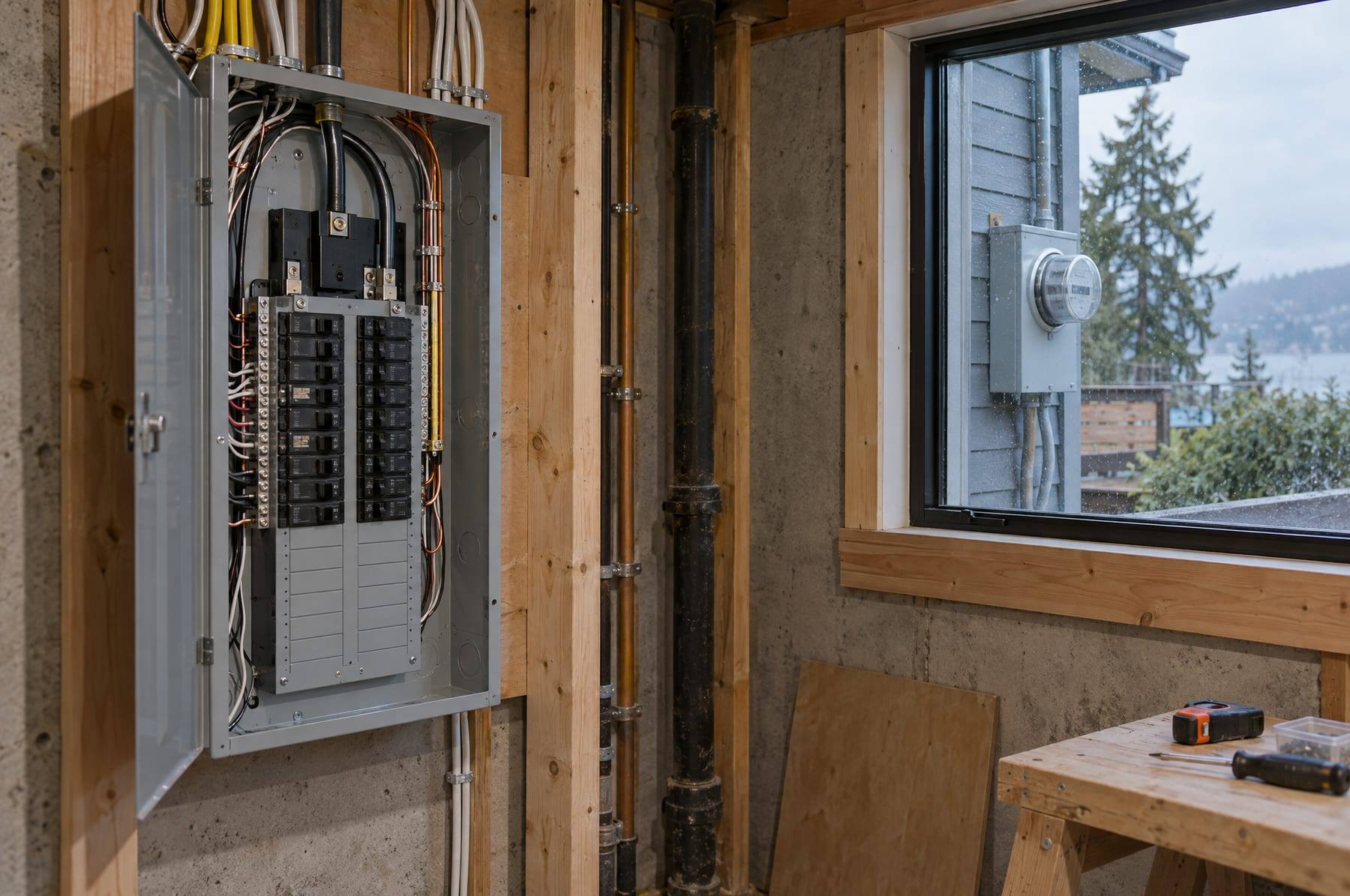
- 03Will I need a bigger electrical panel?
- 04What happens to the gas line?
- 05Does an induction cooktop still need a range hood?
- 06Are there rebates for switching to induction in 2026?
- 07What should I check before buying an induction range?
What changes when a kitchen goes from gas to induction?
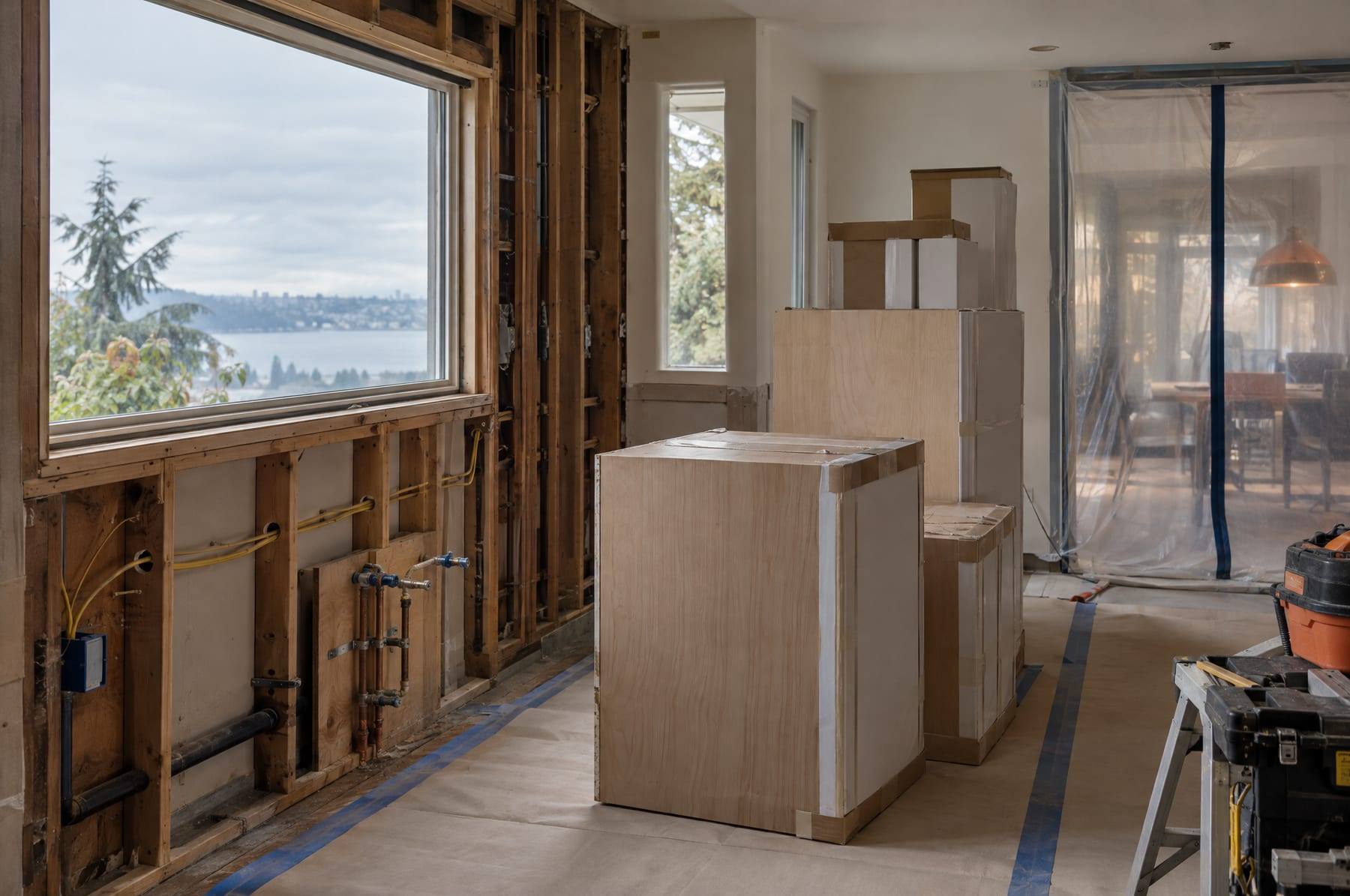
Four things, usually in this order: an electrician runs a new circuit, a plumber caps or removes the gas line, the range hood is checked or replaced, and the new range goes in. If the new range is the same width as the old one, the cabinets and counters can stay.
Induction heats the pan itself through a magnetic field. ENERGY STAR says about 85% of the heating energy reaches what is in the cookware, against about a third with gas, and that the cooktop surface is not hot to the touch without a pan in place. It needs compatible cookware: cast iron, enameled cast iron and stainless steel are ENERGY STAR's examples, and a magnet that sticks to the bottom of a pan is the quick test.
| Part | What is done | Permit in Seattle |
|---|---|---|
| New range circuit | A 240-volt circuit sized to the range's installation manual, run from the panel | Electrical permit, SDCI |
| Panel or service upgrade, if needed | A larger panel or service; Seattle City Light is involved in any service change | Electrical permit, SDCI |
| Gas line | The range's gas supply shut off and capped, or the branch removed | Gas piping permit, Public Health Seattle and King County |
| Range hood | Kept if it vents outside and is large enough; otherwise replaced and ducted outdoors | Electrical permit if new wiring is run |
| The range | Set, connected and tested | Checked at the electrical final inspection |
Outside Seattle, ask the city's building department which agency issues each permit. Public Health issues gas piping permits in Seattle, Clyde Hill and unincorporated King County; other King County cities issue their own.
What circuit does an induction range need?
Most need a dedicated 240-volt circuit, sized from the range's installation manual and the electrical code. Of the 62 induction ranges on ENERGY STAR's list of certified residential electric cooking products on November 26, 2026, 47 list a current rating of 40 amps or more at 240 volts, and 10 list 15 amps. Cooktops vary more: of 68 induction cooktops on the list, 36 are rated 40 to 50 amps, 26 between 21 and 39 amps, and 4 run on 120 volts.
A gas range usually needs only an ordinary 120-volt outlet for its igniter and clock, so a kitchen that cooked with gas rarely has the right wire in place. The electrician runs new cable from the panel, which is easiest while walls or the basement ceiling are open.
In Seattle the circuit needs an electrical permit from SDCI, which issues many of them online the same day. On the 2026 fee schedule a 30 to 50 amp circuit is $43.80 plus a $55.48 administrative fee, with a $105.12 minimum and a 5% technology fee, so a permit for the range circuit alone comes to about $110. Owners who own and live in the house may do their own electrical work; a hired electrician must hold a Washington electrical contractor license.
Will I need a bigger electrical panel?
Maybe. Two questions decide it: whether the panel has room for a two-pole breaker, and whether the service can carry the new load alongside everything else the house runs. The electrician works that out before the range is bought. A house with gas heat and a gas water heater usually has more room than one that already runs electric heat, a heat pump, an electric dryer and a car charger.
If the service must grow, it is a separate and larger job. SDCI's electrical permit page tells applicants to coordinate service changes with Seattle City Light, and the 2026 fee for a new or altered service of 150 to 200 amps is $292 before the administrative and technology fees. The panel upgrade article covers the load check and the choices.
What happens to the gas line?
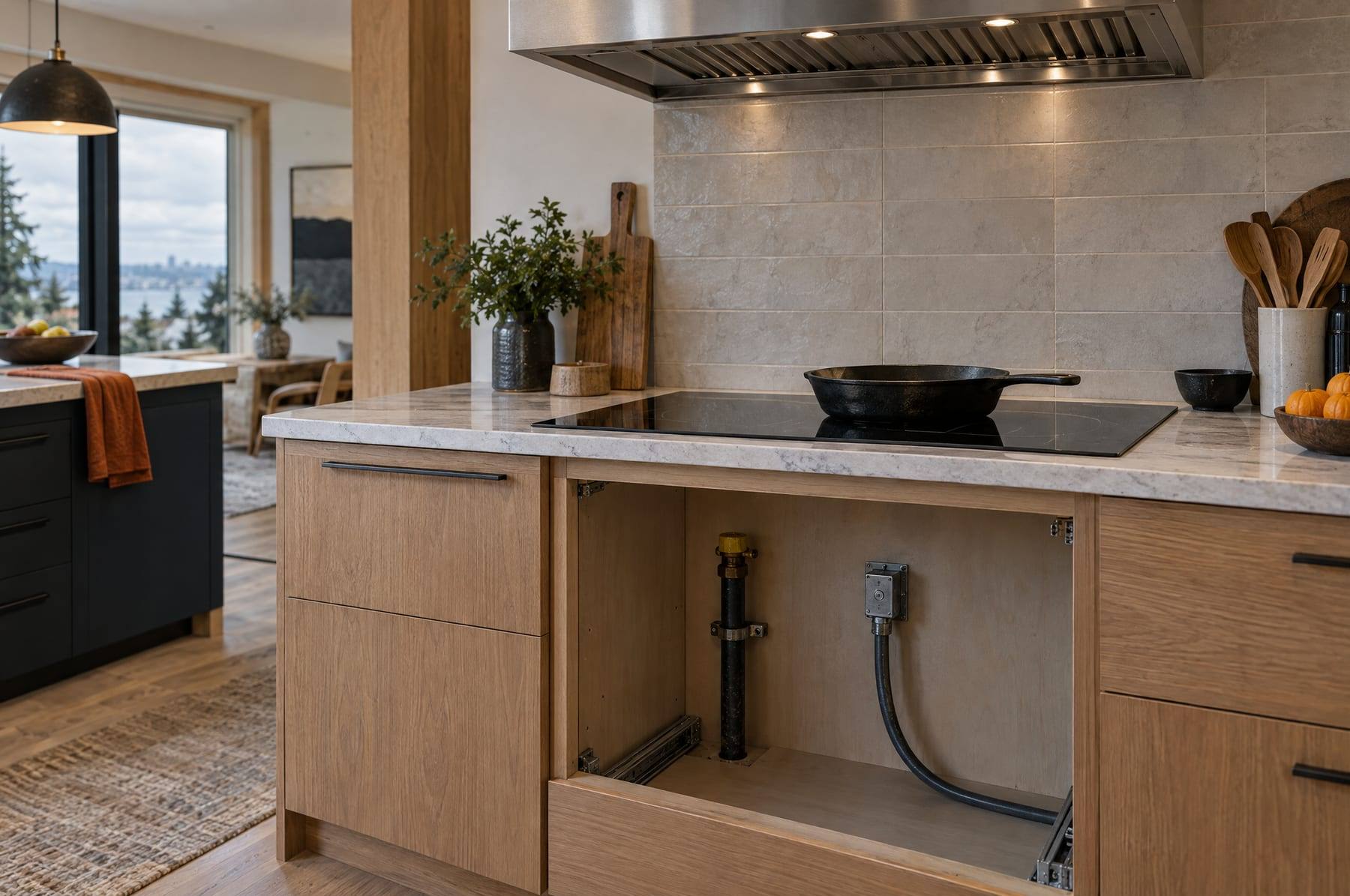
The range's gas supply is shut off and capped at the outlet, or the branch is removed back to where it leaves the main line. Either way it is a change to the gas piping. Public Health Seattle and King County requires a permit when gas piping is installed, moved or altered, and its 2026 fee for a gas piping permit is $137 plus $27 per outlet. Public Health says a hired plumber must be a registered contractor.
Removing gas from the kitchen can also change the makeup air question for a big hood. Seattle's code requires makeup air for an exhaust system able to move more than 400 cfm when the home has a gas, liquid or solid fuel-burning appliance inside its air barrier that is neither direct-vent nor mechanically vented (SRC M1503.6). Whether that still applies after the range goes depends on the furnace, water heater and fireplace that remain.
If the range was the last gas appliance in the house, ask the gas utility about the meter and the monthly charge before assuming either goes away.
Does an induction cooktop still need a range hood?
Yes. Washington's residential code, which Seattle's code carries, requires a local exhaust system in every kitchen (M1505.4.4.1). What changes is the minimum. A hood over an electric range, induction included, must move at least 160 cubic feet per minute or meet a minimum capture efficiency tested to ASTM E3087; over a combustion range the floor is 250 cfm or 80% capture efficiency (WAC 51-51-1505, Table M1505.4.4.3).
| Rule | Requirement | Section |
|---|---|---|
| Hood over an electric or induction range | At least 160 cfm, or the minimum capture efficiency | Table M1505.4.4.3 |
| Hood over a gas range | At least 250 cfm, or 80% capture efficiency | Table M1505.4.4.3 |
| Open kitchen | An intermittent hood; continuous exhaust alone is not permitted | Table M1505.4.4.1 |
| Enclosed kitchen | A hood, or continuous exhaust of 5 air changes an hour of the kitchen's volume | Table M1505.4.4.1 |
| Where the air goes | Outdoors, through a smooth, airtight duct with a backdraft damper, never into an attic or crawl space. A listed ductless hood is allowed only in an enclosed kitchen with continuous exhaust | M1503.3 |
| Duct material | Galvanized steel, stainless steel or copper | M1503.4 |
| Noise | Intermittent kitchen fans rated 3 sones or less at a setting of 100 cfm or more | M1505.4.4.2 |
| Makeup air | Required above 400 cfm when a fuel-burning appliance that is not direct-vent or mechanically vented is inside the air barrier | M1503.6 |
From the 2021 Seattle Residential Code, chapter 15, and WAC 51-51-1505. The minimum capture efficiency over an electric range reads 65% in the WAC text and 60% in Seattle's printed code; ask the inspector which applies before relying on a capture efficiency rating.
A hood that met the rule over gas will meet it over induction, so a kitchen can usually keep a hood that already vents outside. The time to fix a hood that recirculates into the room or vents into the attic is while the range is out.
Are there rebates for switching to induction in 2026?
Not from the utilities, for most households. On November 26, 2026, Seattle City Light's home energy rebates covered heat pumps, heat pump water heaters, front-load washers, heat pump dryers, smart thermostats for electric heat and thermostatic shut-off valves for showers. Puget Sound Energy's residential rebate list covered clothes dryers and washers, EV chargers, heating and cooling, insulation, smart thermostats, water heating and windows. Neither listed a rebate for an induction range or cooktop.
The state program is the one to check. Washington's Department of Commerce runs the State Home Electrification and Appliance Rebates (HEAR) program, which funds 40 local administrators. Eligible equipment includes residential induction cooking equipment and the electric panel and wiring upgrades needed to install new electric equipment, and all equipment must be ENERGY STAR or AHRI certified. Households at or below 150% of area median income qualify, each administrator sets its own amounts, and Commerce posts an administrator's contact once its contract is final.
Federal tax credits do not help here. The IRS says the Energy Efficient Home Improvement Credit applies to property placed in service before December 31, 2025, and its list of qualifying property does not include ranges or cooktops. The energy rebate calculator checks the utility programs for the rest of the house.
What should I check before buying an induction range?
- The installation manual's circuit size, and whether the range plugs in or is wired directly.
- Free breaker spaces and the service size on the panel label.
- That the range's width matches the cabinet opening.
- Whether the hood vents outside, and its rated airflow.
- Cookware: a magnet should stick to the bottom of each pan you plan to keep.
- ENERGY STAR certification, if you plan to apply for a HEAR rebate.
- Who will apply for the electrical and gas permits, and who schedules the inspections.
When the switch is part of a larger kitchen remodel, the kitchen remodel timeline shows where the circuit, the gas work and the hood fit in the order of work.
Questions people also ask
01Can I plug an induction range into my old range outlet?
02Do I need new pots and pans for induction?
03Do I need a permit just to swap a gas range for induction in Seattle?
04Is induction cooking safer than gas?
05How do I find a HEAR rebate administrator?
Sources
- 01ENERGY STAR: Electric cooking products (induction efficiency and cookware) (read Nov 26, 2026)
- 02ENERGY STAR: Certified residential electric cooking products (product list and ratings) (read Nov 26, 2026)
- 03Seattle SDCI: Electrical permit (read Nov 26, 2026)
- 04Seattle SDCI: 2026 Fee Subtitle, Table D-15 electrical permit fees (read Nov 26, 2026)
- 05Public Health Seattle and King County: plumbing and gas piping applications and permits (read Nov 26, 2026)
- 06Public Health Seattle and King County: plumbing and gas piping fees, effective Jan. 1, 2026 (read Nov 26, 2026)
- 072021 Seattle Residential Code, chapter 15: exhaust systems (M1503, M1505) (read Nov 26, 2026)
- 08WAC 51-51-1505: Washington amendments, mechanical ventilation and kitchen exhaust rates (read Nov 26, 2026)
- 09Seattle City Light: Home energy rebates (read Nov 26, 2026)
- 10Puget Sound Energy: Residential rebates and offers (read Nov 26, 2026)
- 11Washington State Department of Commerce: State Home Electrification and Appliance Rebates (HEAR) (read Nov 26, 2026)
- 12IRS: Energy Efficient Home Improvement Credit (reviewed Apr. 28, 2026) (read Nov 26, 2026)
Rules, rates and programs change. This article was checked against the sources above on the dates shown. It is general information for homeowners, not legal, tax or engineering advice for a specific property.