The short answer
A useful remodeling estimate prices a defined scope line by line, names the allowances and the exclusions, shows Washington sales tax as its own line on the whole contract (10.55% in Seattle for October 1 to December 31, 2026), and says who obtains and pays for the permits. Washington's Department of Labor and Industries advises getting at least three written bids and a written contract that states the price with tax, the payment terms, the work, the materials, the warranties and the change order process.
Key points
- 01Compare bids on the same scope: list what each one includes and excludes before you compare totals.
- 02An allowance is a placeholder price for something not yet chosen; if your choice costs more, the difference is added to the contract.
- 03Washington taxes labor and materials alike, and a contract price is presumed not to include the tax, so look for a separate tax line.
- 04Before work starts on a home job of $1,000 or more, the contractor must give you the state's disclosure statement under RCW 18.27.114.
In this article (6 sections)
- 01What is the difference between an estimate, a bid and a contract?
- 02What should each part of a remodeling estimate tell you?
- 03What is an allowance in a remodeling estimate?
- 04Which exclusions should you look for in a remodel estimate?
- 05How do you compare two remodeling bids fairly?
- 06What paperwork should come with a remodeling contract?
What is the difference between an estimate, a bid and a contract?
An estimate is a contractor's price for the work as it is understood at the time, usually after a visit to the house. A bid is a price offered against a defined set of drawings, often in competition with others. The contract is what binds both sides: it fixes the scope, the price, the payment schedule and the process for changes. The words overlap in practice, so read what a document commits to, not what it is called.
Washington's Department of Labor and Industries (L&I) advises getting at least three written bids, comparing them carefully and signing a written contract you understand. Its hire smart guide says a contract should include, at a minimum:
- The total price, including sales tax.
- Payment terms and the completion date.
- Permit fees, if any.
- The specific work to be done.
- A list of materials, major suppliers and subcontractors.
- Warranties and the process for change orders.
A good estimate already carries most of that list, so the contract can be checked against it line by line.
What should each part of a remodeling estimate tell you?
| Part | What it should say | Why it matters |
|---|---|---|
| Scope of work | Room by room, what is removed, built, moved and finished | Anything not written here is outside the price |
| Line items | Each trade or phase priced: demolition, framing, electrical, plumbing, drywall, tile, cabinets, finishes | Shows where the money goes and makes bids comparable |
| Allowances | A dollar amount for each item not yet chosen, with its unit | A choice above the allowance becomes an added cost |
| Exclusions | What the price does not cover | The most common source of surprise costs |
| Permits and inspections | Which permits, who applies, and whether the fees are in the price | L&I says the contractor usually obtains the permits |
| Sales tax | The rate and the amount, on the whole contract | Washington presumes a quoted price does not include tax |
| Payment schedule | A deposit and draws tied to completed stages of work | Keeps payments in step with progress |
| Schedule | A start date, a completion date and what can move them | L&I lists the completion date among contract terms |
| Warranty | What is covered, for how long and how to make a claim | L&I lists warranties among the terms a contract should state |
| Change orders | How a change is priced and approved in writing before the work | L&I advises against verbal amendments |
Line items will not always show the contractor's markup on each part, but they should be detailed enough that you can see what changes if you drop or add something. A single lump sum for 'kitchen remodel' tells you nothing you can compare.
What is an allowance in a remodeling estimate?
An allowance is a placeholder: a sum the estimate sets aside for something you have not chosen yet, such as tile, a faucet or light fixtures. If the item you pick costs less than the allowance, the contract price goes down. If it costs more, the difference is added, with sales tax. Allowances let a project be priced before every selection is made, but a low allowance makes an estimate look cheaper than the job will be.
- Each allowance says what it covers, material only or material and labor, and its unit: per square foot, per fixture or a lump sum.
- The allowance matches the finish level you expect. A tile allowance set for basic tile will not cover handmade tile.
- The estimate says how an overage or a credit is handled and when it is billed.
- The total of all allowances is easy to find, so you know how much of the price is still undecided.
Which exclusions should you look for in a remodel estimate?
The exclusions list is where two estimates that look alike part ways. Read it as carefully as the price. Items that are often left out of a remodel price include:
- Asbestos testing and removal. The Puget Sound Clean Air Agency requires a check for asbestos before any renovation project. An owner who lives in the single-family house being remodeled may do the survey personally; in other cases an AHERA-certified building inspector must do it.
- Lead-safe work in a home built before 1978, which must be done by a firm certified for renovation, repair and painting work. In Washington the Department of Commerce certifies those firms.
- An electrical panel or service upgrade found necessary once the new load is calculated. See panel upgrades.
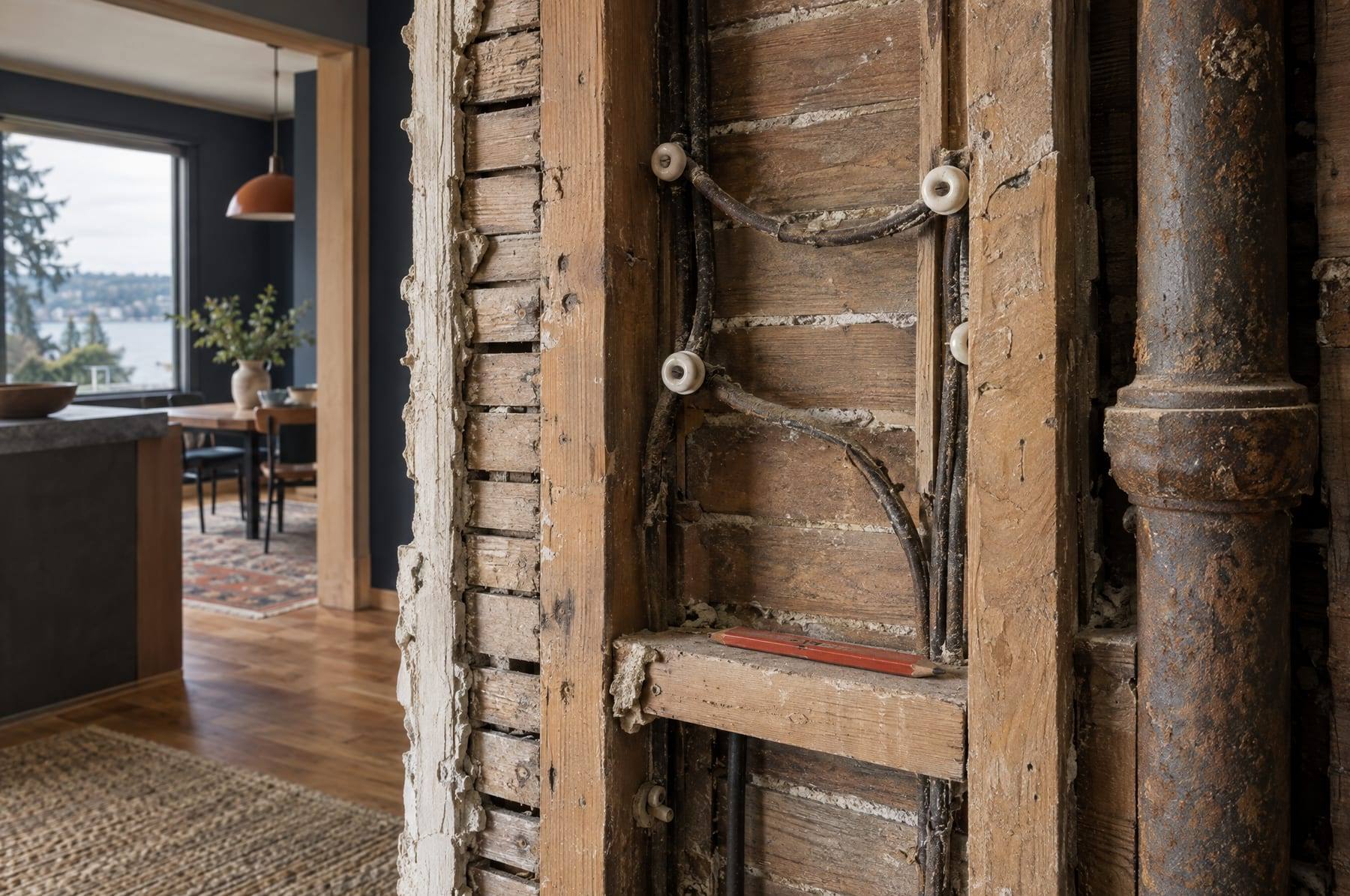
- Repair of rot, damaged framing or old wiring found when walls are opened.
- Appliances, plumbing fixtures or light fixtures you supply.
- Structural engineering, if a new beam spans more than Seattle allows without an engineer's stamp.
- Painting, flooring or patching outside the work area.
An exclusion is not a warning sign by itself. A contractor cannot price what nobody can see. What matters is that the estimate says how hidden conditions will be handled: found, shown to you, priced in writing and approved before the work goes ahead. The change orders article covers that process.
How do you compare two remodeling bids fairly?
- 01
Line them up on one sheet
Put every part of each bid side by side: scope, allowances, exclusions, permits, tax and schedule.
- 02
Fill the gaps
Where one bid includes an item and another excludes it, ask the second contractor for a price for it and add that to their total.
- 03
Match the allowances
Raise any low allowance to the level you expect to choose, on every bid.
- 04
Add the tax
Bring each bid to a total with sales tax at the job site's rate. The sales tax article lists the rates.
- 05
Check each contractor
Look up registration, bond and insurance with L&I's Verify a Contractor tool. The contractor check article walks through the record.
- 06
Ask about the outliers
A bid far below the others usually prices a smaller job. Ask what it leaves out before you count the difference as a saving.
What paperwork should come with a remodeling contract?
Before work starts on a home job of $1,000 or more, Washington law requires the contractor to give you a disclosure statement, the Notice to Customer set out in RCW 18.27.114. It states the contractor's registration number, the bond on file and the registration's expiration date. It warns that the bond might not be enough to cover a claim, and that your property can be liened if suppliers or subcontractors are not paid. A contractor who does not provide it cannot bring a lien claim on that contract.
- The contractor's registration number, matching L&I's record.
- The disclosure statement, signed by you, with a copy for your files.
- A payment schedule tied to stages of work. The payment schedule article explains deposits, draws and lien releases.
- The written warranty terms.
- The change order process, in writing.
- Who obtains the permits and requests inspections before work is covered.
Giant Builders gives a free in-home estimate that is written and itemized, and prepares and files the permits for the work.
Questions people also ask
01Why is one remodeling bid so much lower than the others?
02Is a contingency line in a contractor's estimate normal?
03Should I sign the estimate?
04Do I pay sales tax on the allowances?
05Who should pull the permit, me or the contractor?
Sources
- 01Washington L&I: Hire smart, step by step (read Nov 26, 2026)
- 02Washington L&I: Hiring a contractor (read Nov 26, 2026)
- 03Washington L&I: Verify a contractor (read Nov 26, 2026)
- 04RCW 18.27.114: disclosure statement required (read Nov 26, 2026)
- 05RCW 82.08.050: buyer to pay, seller to collect tax (read Nov 26, 2026)
- 06Washington Dept. of Revenue: construction guide, custom construction (read Nov 26, 2026)
- 07Washington Dept. of Revenue: local sales and use tax rates, October 1 to December 31, 2026 (read Nov 26, 2026)
- 08Puget Sound Clean Air Agency: asbestos and renovation (read Nov 26, 2026)
- 09Washington Dept. of Commerce: Renovation, Repair and Painting program (read Nov 26, 2026)
- 10Seattle SDCI Tip 316: Subject-to-field-inspection permits (updated Oct. 29, 2026) (read Nov 26, 2026)
- 11HUD: Handbook 4000.1, Standard 203(k) contingency reserves (last revised Nov. 26, 2025) (read Nov 26, 2026)
Rules, rates and programs change. This article was checked against the sources above on the dates shown. It is general information for homeowners, not legal, tax or engineering advice for a specific property.