The short answer
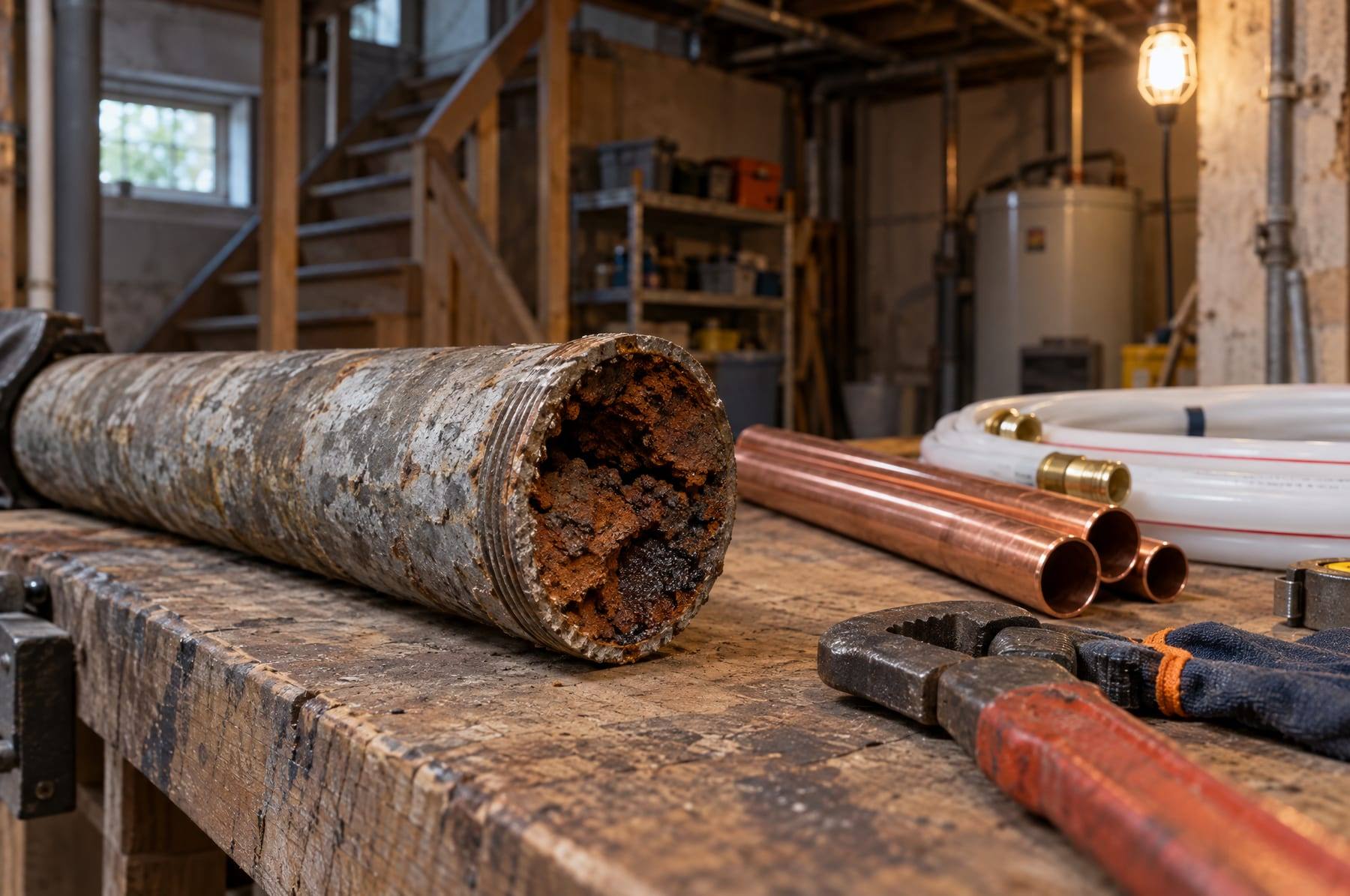
Galvanized steel water pipe, common in houses built before the 1960s, rusts from the inside once its zinc coating wears away. HUD's inspection guide puts its service life at 20 to 50 years and names rust-colored water and low pressure as signs of advanced wear. Seattle Public Utilities reports no known lead service lines in its system, but old solder and brass fixtures can add lead. In Seattle, a repipe needs a plumbing permit from Public Health Seattle and King County: $137 plus $27 per fixture listed, effective January 1, 2026.
Key points
- 01A magnet sticks to galvanized steel pipe but not to copper, plastic or lead, and a scratch on galvanized stays dull gray.
- 02HUD puts galvanized pipe's service life at 20 to 50 years; rust-colored water and low pressure mean advanced wear.
- 03Seattle Public Utilities reports no known lead service lines, but lead can come from old solder and brass, and a lab test costs $25 to $50.
- 04Joints between galvanized and copper corrode unless a dielectric coupling separates them, so partial repipes need care.
- 05In Seattle, a house repipe is an over-the-counter Public Health plumbing permit: $137 plus $27 for each fixture listed, in 2026.
In this article (7 sections)
- 01How can I tell if my pipes are galvanized?
- 02How long do galvanized pipes last, and what are the warning signs?
- 03Do galvanized pipes put lead in Seattle's water?
- 04Should I repipe the whole house or only the remodeled rooms?
- 05Which pipes are mine and which belong to the utility?
- 06What permit does a repipe need?
- 07How does a repipe go, step by step?
How can I tell if my pipes are galvanized?
Find a bare stretch of water pipe near the water heater, the main shutoff or under the house, and hold a magnet to it. East Bay Municipal Utility District, a public water utility in California, gives the test: a magnet sticks only to iron and steel pipe, not to copper, plastic or lead. Then scratch the surface with a coin or key: galvanized pipe stays dull gray, copper looks like a penny, and lead is soft and turns shiny silver.
Galvanized pipe is steel dipped in molten zinc. Saint Paul Regional Water Services dates its use in homes from the 1880s to the 1960s, copper from the 1930s and most widely from the 1960s on, and PEX (cross-linked polyethylene, a flexible plastic) to most homes built since the late 1990s. A house can have a mix, with copper or PEX added where rooms were remodeled, which HUD treats as a reason to look closely.
How long do galvanized pipes last, and what are the warning signs?
HUD's Residential Rehabilitation Inspection Guide puts the service life of galvanized steel water pipe at 20 to 50 years, depending on the quality of the pipe and its joints and on the minerals in the water. In a house built before the 1960s, original galvanized pipe is past that range.
- Service life of galvanized steel water pipe (HUD)
- 20 to 50 years
- Service life of galvanized steel water pipe (HUD)
- Normal service life of copper water pipe (HUD)
- 50+ years
- Normal service life of copper water pipe (HUD)
- Cast iron waste pipe, an industry estimate in HUD's appendix
- 75 to 100 years
- Cast iron waste pipe, an industry estimate in HUD's appendix
- Rust-colored water, especially from the hot water lines (HUD)
- Low flow and low pressure, or pressure that differs from fixture to fixture (HUD, Saint Paul Regional Water Services)
- Rusted fittings, and leaks near joints and pipe supports (HUD)
- Brown stains in sinks (Saint Paul Regional Water Services)
The zinc coating wears away first. Then the steel rusts, and the corrosion builds up in mounds called tubercles that narrow the pipe and block flow (EBMUD), until the pipe rusts through and leaks. HUD's guide says galvanized pipe need not be replaced unless it shows deterioration, leaks or restricted flow, but that if galvanized steel piping is exposed during a rehabilitation, replacing it should be considered.
Do galvanized pipes put lead in Seattle's water?
Seattle's water leaves the utility lead-free; the risk sits in house plumbing. Seattle Public Utilities (SPU) says its sources do not contain lead and there are no known lead service lines in its distribution system, though a small number of homes may have short lead connections. Lead can leach from lead-based solder and brass fixtures, and SPU treats the water to reduce corrosion.
Galvanized pipe matters here in two ways. EBMUD notes that the zinc coating itself can contain lead, and that where a lead pipe was once connected upstream, lead-bearing scale can form inside galvanized pipe and come loose later. EPA says lead pipes, fixtures and solder are more likely in homes built before 1986, and federal law now limits lead in plumbing products to a weighted average of 0.25% (SPU dates that limit to January 2014).
To test, SPU points to a lab certified by the Washington Department of Ecology; analysis costs $25 to $50. When water has sat in the pipes for more than six hours, SPU advises running the tap for 30 seconds to 2 minutes before drinking, and using cold water for drinking and cooking.
Should I repipe the whole house or only the remodeled rooms?
If the remodel opens most of the plumbing walls, replace the whole supply system; if it opens one room, replace back to a sound connection and plan the rest. HUD's guide calls a mix of galvanized steel and copper or brass a sign of potential trouble, because joints between dissimilar metals corrode by galvanic action unless a dielectric coupling separates them. No separation is needed between metal and plastic pipe.
HUD also says low flow and low pressure in these systems come from rust and mineral deposits in the galvanized pipe, so a new bathroom fed by old galvanized pipe upstream can still see weak flow.
| Scope | What is replaced | When it fits |
|---|---|---|
| Room only | Supply lines inside the remodeled room, back to a sound connection | One room is open and the rest of the pipe still performs well |
| Main runs | The main line from the shutoff, the water heater connections and the trunk lines under the house | Pressure is low everywhere, or a whole-house project is phased |
| Whole house | All hot and cold supply piping, with shutoff valves at the fixtures | Most walls are open, or rust and leaks show up in several places |
Which pipes are mine and which belong to the utility?
In Seattle, the property owner is responsible for installing and maintaining the private water line from the city's union, at the meter, to the building's plumbing (SPU). Changing the water service itself goes through an SPU water service application. The side sewer is also the owner's, from the house to the public sewer main under the street, including the part beyond the property line, and SPU takes side sewer permit questions at (206) 684-5362.
In other cities, the water district or city utility draws its own line, so ask yours before a project that changes the service.
What permit does a repipe need?
A plumbing permit, from Public Health Seattle and King County in Seattle, Clyde Hill and unincorporated King County, and from the city's building department in other King County cities. Public Health requires a permit whenever a plumbing system is installed, relocated or changed. A homeowner's permit authorizes the homeowner to do the plumbing personally (RCW 18.106.150); a plumber you hire must be a registered contractor.
For a single-family house, Public Health treats a repipe as an over-the-counter permit applied for online, without plan review; its plan review rule for re-pipes covers buildings of three or more stories and exempts single-family houses. The permit lists the re-pipe as representative fixtures (hot water, cold water and drainage), plus any fixture being replaced that needs in-wall plumbing changes.
| Item | Fee |
|---|---|
| Plumbing permit | $137 plus $27 per fixture |
| Re-inspection | $137 |
| Plan review, where required | $273 an hour |
| Permit renewal | $68 |
| Work done before a permit (Already Built Construction permit) | $273 plus $55 per fixture |
Example: a re-pipe of hot and cold water plus one new tub and shower valve lists three fixtures: $137 + 3 x $27 = $218. For re-pipes that go through plan review, Public Health adds a supplemental fee set by the number of inspections agreed in advance on its R-20 worksheet.
How does a repipe go, step by step?
- 01
Test and look
Check pressure at several fixtures, identify the pipe material at the meter and the water heater, and test the water if lead is a concern. If pipe wrap or old flooring will be disturbed, the asbestos survey the Puget Sound Clean Air Agency requires comes first.
- 02
Plan the routes
Run new lines through the crawl space, basement and attic where possible, to keep wall openings small, and plan shutoff valves at each fixture.
- 03
Get the permit
In Seattle, an online over-the-counter permit from Public Health; elsewhere, from the city.
- 04
Run and connect
New piping goes in alongside the old, and the water is shut off while each line is switched over.
- 05
Inspect
Public Health inspects the new piping; schedule it before walls and floors are closed. A failed inspection means a $137 re-inspection.
- 06
Flush and patch
Flush the new lines, check each fixture, and patch the openings.
The bathroom and kitchen permit guides cover the rest of the plumbing in a remodel: bathroom permits in Seattle. Giant Builders includes the pipe check in its free in-home estimate; the plumbing permit is pulled by the plumbing contractor doing the work, as Public Health's process sets out.
Questions people also ask
01Is PEX or copper better for a repipe?
02What about plastic pipe marked PB?
03Can I do my own plumbing in Seattle?
04Are there loans for plumbing or sewer repairs in Seattle?
05How long does it take to get a repipe permit?
Sources
- 01HUD: Residential Rehabilitation Inspection Guide (National Institute of Building Sciences, February 2000) (read Nov 26, 2026)
- 02East Bay Municipal Utility District: Galvanized iron pipes (read Nov 26, 2026)
- 03Saint Paul Regional Water Services: Plumbing information for homeowners (read Nov 26, 2026)
- 04Seattle Public Utilities: Lead in water (read Nov 26, 2026)
- 05Seattle Public Utilities: Water quality monitoring results (read Nov 26, 2026)
- 06U.S. EPA: Basic information about lead in drinking water (read Nov 26, 2026)
- 07Seattle Public Utilities: Water service (construction resources) (read Nov 26, 2026)
- 08Seattle Public Utilities: Your side sewer (read Nov 26, 2026)
- 09Public Health Seattle and King County: Plumbing and gas piping applications and permits (read Nov 26, 2026)
- 10Public Health Seattle and King County: Plumbing and gas piping fees, effective January 1, 2026 (read Nov 26, 2026)
- 11Public Health Seattle and King County: Plumbing permit application process for re-pipe projects (updated December 30, 2024) (read Nov 26, 2026)
- 12Puget Sound Clean Air Agency: Contractor renovation (asbestos) (read Nov 26, 2026)
- 13Seattle Office of Housing: Home repair loans and grants (read Nov 26, 2026)
Rules, rates and programs change. This article was checked against the sources above on the dates shown. It is general information for homeowners, not legal, tax or engineering advice for a specific property.