The short answer
Seattle's tree code, SMC chapter 25.11, sorts trees 6 inches or more in trunk diameter into four tiers. For an addition or backyard cottage in a Neighborhood Residential zone, Tier 3 and Tier 4 trees may be removed under the permit, Tier 3 with replacement. A Tier 2 tree, 24 inches or more, may go only if keeping it would block the zone's 50 percent lot coverage, leave part of a home under 10 feet wide, or block required access or utilities. Heritage trees stay unless hazardous. Without a project, two Tier 4 trees may go in three years.
Key points
- 01Seattle protects trees by tier: Tier 4 from 6 to 12 inches, Tier 3 from 12 to 24, Tier 2 at 24 inches and more, and Tier 1 heritage trees.
- 02Without a development permit, a Neighborhood Residential lot may lose only two Tier 4 trees in any three years without city approval.
- 03In a Neighborhood Residential zone, a Tier 2 tree may come down for a project only if it meets one of three tests in SMC 25.11.070.
- 04A protected tree's protection area is a radius of one foot per inch of trunk diameter, which can be reduced only within limits.
- 05A project that removes or harms a Tier 1, 2 or 3 tree cannot use Seattle's quick STFI permit.
In this article (8 sections)
- 01Which trees does Seattle protect?
- 02What changed in Seattle's tree code, and when?
- 03Can I remove a tree before I apply for a permit?
- 04When can a large tree be removed for an addition or DADU?
- 05How much room does a protected tree need during construction?
- 06What does replacing a tree or paying in lieu cost?
- 07Can keeping a tree help the project?
- 08How do trees affect the permit route?
Which trees does Seattle protect?
Trees with a trunk at least 6 inches across, sorted into four tiers by size and status. Size is measured as diameter at standard height (DSH): the trunk's diameter 4.5 feet above the ground. SDCI's Tip 242B explains the edge cases: on a slope, measure on the uphill side, and for a tree that splits into several trunks at the ground, the DSH is the square root of the sum of each trunk's DSH squared.
| Tier | Which trees | Rule when you build in a Neighborhood Residential zone |
|---|---|---|
| Tier 1 | Heritage trees designated under the city's Heritage Tree Program | May not be removed unless hazardous or in an emergency; replacement required |
| Tier 2 | 24 inches DSH or more; every tree in a grove of eight or more trees of 12 inches or more with a continuous canopy; certain species below 24 inches named by Director's Rule 7-2024 | May be removed only if one of the tests in SMC 25.11.070 is met; replacement required |
| Tier 3 | 12 inches DSH or more but under 24 inches | May be removed as part of a development permit; replacement required |
| Tier 4 | 6 inches DSH or more but under 12 inches | May be removed as part of a development permit; no replacement required |
| Under 6 inches | Smaller trees | Not regulated by the tier rules |
SMC 25.11.130 as amended through Ordinance 127376, and SDCI Tip 242B (updated October 1, 2025). Trees on a neighbor's lot whose canopy or roots extend over yours must be retained.
What changed in Seattle's tree code, and when?
The current code dates from Ordinance 126821, passed in May 2023 and in effect July 30, 2023, which rewrote SMC 25.11 around the four tiers, added limits on removal, the registry of tree service providers, public notices and the option to pay in lieu of replanting. It also removed the old exemption for additions to existing houses, so an addition is treated like any other development.
The most recent change for homeowners came with the Neighborhood Residential update, Ordinance 127376, passed December 16, 2025 and in effect January 21, 2026. It deleted the fixed basic tree protection area, so the same adjustable protection area now decides both whether a Tier 2 tree may be removed and how a kept tree is protected during construction. It also cut the minimum width in the Tier 2 test from 15 feet to 10. Some SDCI Tips predate that update, so read them alongside the current code.
Can I remove a tree before I apply for a permit?
Only a little. When no development is proposed, SDCI's Tip 242B says removal of Tier 1 to Tier 4 trees is generally prohibited. On a developed lot in a Neighborhood Residential zone, you may remove no more than two Tier 4 trees in any three-year period without city review, with no replacement. Other removals need SDCI approval for a listed reason: a hazardous tree rated high risk by a qualified arborist, a dead tree, an infestation, an invasive or nuisance species, access for elderly or disabled residents, or a Tier 3 or Tier 4 tree causing obvious damage to a foundation or utilities.
- Paid tree removal, and pruning of live branches 4 inches or more or roots 2 inches or more, must be done by a tree service provider on the city's registry.
- The provider posts a public notice on SDCI's website at least 6 business days before removing any tree of 6 inches DSH or more, and 3 business days before other reportable work, and posts it on site while the work is done.
- An emergency removal of a tree at extreme risk of imminent failure needs no advance approval, but SDCI must be told first and an application filed within 10 calendar days.
When can a large tree be removed for an addition or DADU?
In a Neighborhood Residential zone, SMC 25.11.070.A allows a Tier 2 tree to be removed only if one of three things is true:
- The maximum lot coverage the zoning allows, 50 percent of the lot in Neighborhood Residential zones, cannot be reached without building into the tree's protection area.
- Avoiding the protection area would leave part of the house or of an accessory dwelling unit less than 10 feet wide.
- Removal is necessary for new structures, required vehicle or pedestrian access, utilities, retaining walls the city requires, or similar improvements.
SDCI explained how it applies the first test in July 2026. The protection areas, and any strip of lot narrower than 10 feet between a protection area and a setback, do not count as buildable area. With several trees on a lot, the analysis uses the sum of all the protection areas, not one tree at a time. In practice, a cottage or addition that fits within the lot's coverage limit while avoiding the tree will usually have to keep it, which is why the tree belongs on the first sketch, not the last.
How much room does a protected tree need during construction?
Start with one foot of radius for every inch of trunk diameter. A tree protection area is the area around a tree where excavation and other construction are prohibited unless the Director pre-authorizes it, and under SMC 25.11.130 it is a circle with that radius, as altered under SMC 25.11.060. A 30-inch tree starts with a 30-foot radius.
- The area may be modified for the tree's species, size, age, health and the soil, but not beyond the feeder root zone.
- New encroachment may come no closer than half the radius; for the 30-inch tree, 15 feet from the trunk.
- The area may not be reduced by more than 35 percent of its outer half unless a certified arborist finds another method gives equal or better protection.
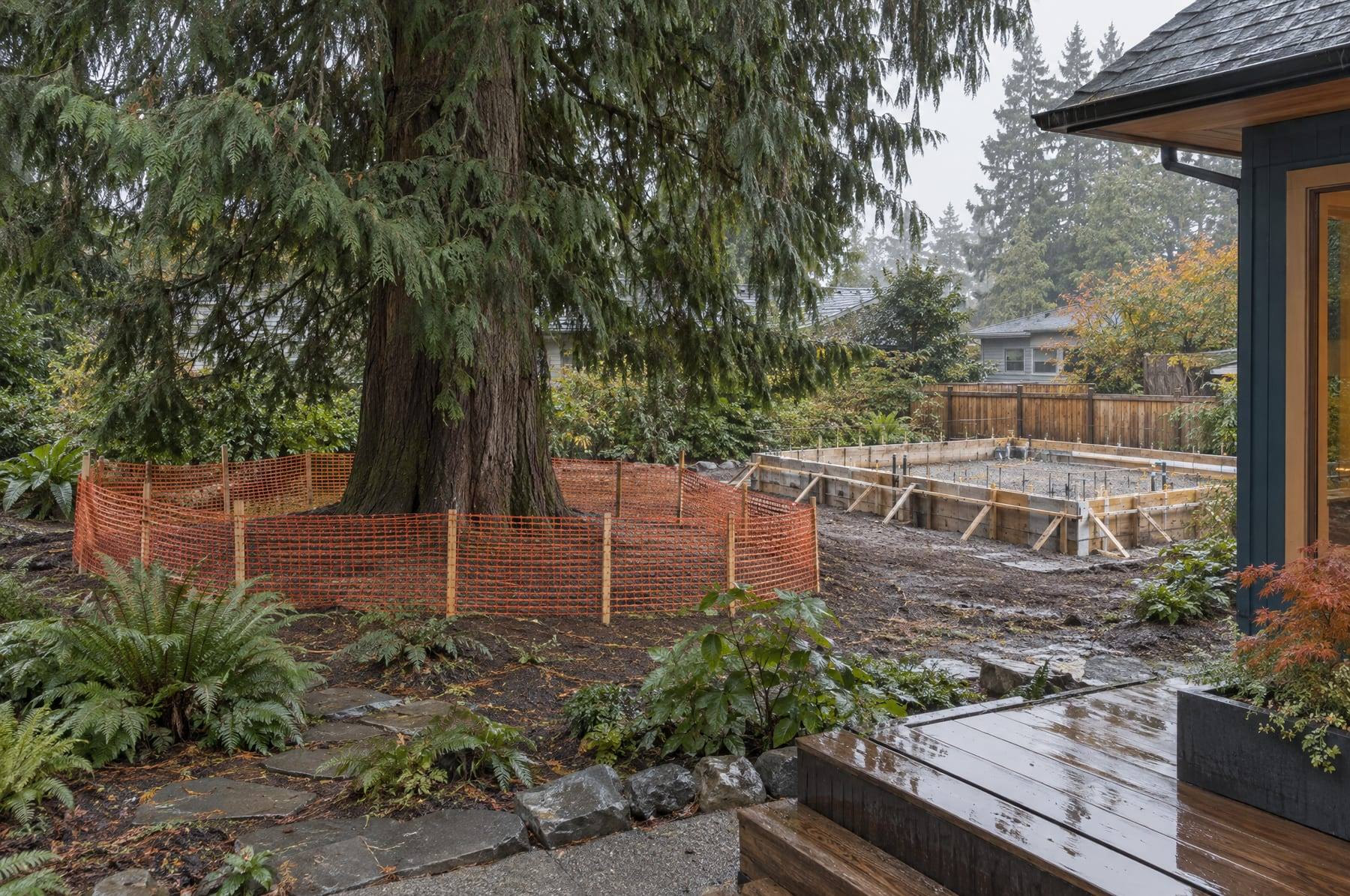
- The protection area needs fencing, signs and other measures from SDCI's Tree and Vegetation Protection Detail during the work.
- All Tier 1 to Tier 4 trees, including a neighbor's trees whose canopy or roots reach your lot, must be shown on every plan sheet of the permit set.
SDCI may require a tree protection report from a certified arborist. Since November 2026 it also offers an early meeting with its reviewing arborists, called a TreeSub, at a minimum cost of one land use hourly rate, which it gives as $551, paid when the appointment is requested.
What does replacing a tree or paying in lieu cost?
Tier 1, 2 and 3 trees removed for development must be replaced by new trees chosen by the Director, sized so that at maturity they give a canopy at least roughly proportional to what was lost, and maintained for five years. Where replanting on site is not possible, the code allows a voluntary payment in lieu, made to SDCI before the permit is issued. Director's Rule 8-2023, in effect since July 31, 2023, sets the amounts.
| Tree removed | How it is priced | Payment |
|---|---|---|
| Tier 2 tree, 24 inches DSH | $17.87 per square inch of trunk cross-section | About $8,084 |
| Tier 2 tree, 30 inches DSH | $17.87 per square inch of trunk cross-section | About $12,632 |
| Tier 2 tree, 36 inches DSH | $17.87 per square inch of trunk cross-section | About $18,190 |
| Tier 1 or Tier 2 tree under 24 inches (grove member or listed species) | Flat amount per tree | $8,080 |
| Tier 3 tree | Flat amount per tree | $2,833 |
The per-inch rows are computed from the rule's formula: pi times the radius squared, times $17.87. The rule says its amounts will be evaluated periodically.
The money goes to planting and maintaining trees in parts of the city with low canopy cover. It does not remove the need to meet the Tier 2 tests: a payment in lieu covers replacement for a tree the code already allows to be removed.
Can keeping a tree help the project?
Yes. The January 2026 Neighborhood Residential code gives back some room for trees that stay.
- Height. SMC 23.44.070 raises the height limit from 32 feet to 42 on a lot that keeps a Tier 1 or Tier 2 tree, or that reaches a tree score giving at least 10 percent canopy at maturity.
- Setbacks. To keep an on-site or neighboring tree, a building may extend into the front or rear setback by an area equal to the protection area of the trees outside the setbacks.
- Amenity area. Development that keeps a Tier 2 tree needs no amenity area under SMC 23.44.110, and other projects may reduce it by the area of the trees kept.
On a lot with a large tree, building up instead of out is often the design that keeps both the tree and the floor area. The second story or bump-out article compares the two, and the Seattle ADU rules cover the cottage side.
How do trees affect the permit route?
They can rule out the quick permit. SDCI's Tip 316, updated October 29, 2026, lists a proposal that adversely impacts any Tier 1, 2 or 3 tree, or proposes removing one, among the projects that do not qualify for a subject-to-field-inspection (STFI) permit. Those go to full plan review, which the permit timelines article shows takes weeks to months.
Street trees follow different rules. Trees in the public right-of-way, including the planting strip in front of many Seattle houses, are managed by the Seattle Department of Transportation, and SDCI notes that all tree removal in the right-of-way requires a permit regardless of the tree's size. The Neighborhood Residential code adds that existing street trees must be kept unless SDOT approves their removal, which matters for a new driveway or a utility trench.
For the additions and backyard cottages we build, we prepare and file the permits, including the site plan the tree code asks for.
Questions people also ask
01Who decides whether a tree on my lot is Tier 2?
02Does the tree code apply to my neighbor's tree?
03Do I need a permit to prune a large tree in Seattle?
04Is a dead tree protected?
Sources
- 01Seattle SDCI Tip 242B: Tree removal on private property (updated Oct. 1, 2025) (read Nov 26, 2026)
- 02Seattle SDCI Tip 242D: Tree public notice (updated Oct. 10, 2024) (read Nov 26, 2026)
- 03Seattle SDCI Tip 316: Subject-to-field-inspection permits (updated Oct. 29, 2026) (read Nov 26, 2026)
- 04Seattle Ordinance 126821: tree protection update, SMC 25.11 (passed May 2023, in effect July 30, 2023) (read Nov 26, 2026)
- 05Seattle Ordinance 127376: Neighborhood Residential update, amends SMC 25.11 and 23.44 (passed Dec. 16, 2025; in effect Jan. 21, 2026) (read Nov 26, 2026)
- 06Seattle SDCI Director's Rule 8-2023: Payment in lieu of tree replacement (in effect July 31, 2023) (read Nov 26, 2026)
- 07Seattle SDCI Director's Rule 7-2024: Designation of Tier 2 trees (read Nov 26, 2026)
- 08SDCI Building Connections: Tree protection regulations and the January 21, 2026 changes (July 1, 2026) (read Nov 26, 2026)
- 09SDCI Building Connections: Early guidance on tree protection (Nov. 3, 2026) (read Nov 26, 2026)
- 10SDCI Building Connections: Single registration for tree service providers with SDCI and SDOT (Feb. 28, 2024) (read Nov 26, 2026)
Rules, rates and programs change. This article was checked against the sources above on the dates shown. It is general information for homeowners, not legal, tax or engineering advice for a specific property.